From Zone 6b to 10b: The Range of USDA Hardiness Across Texas
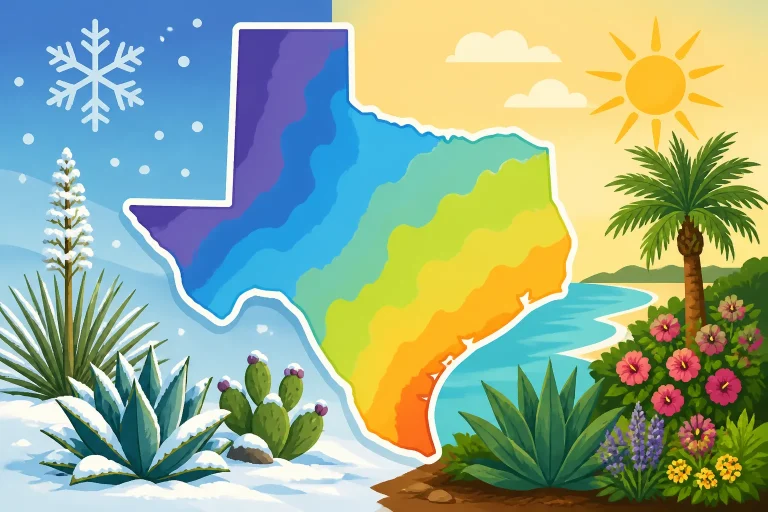
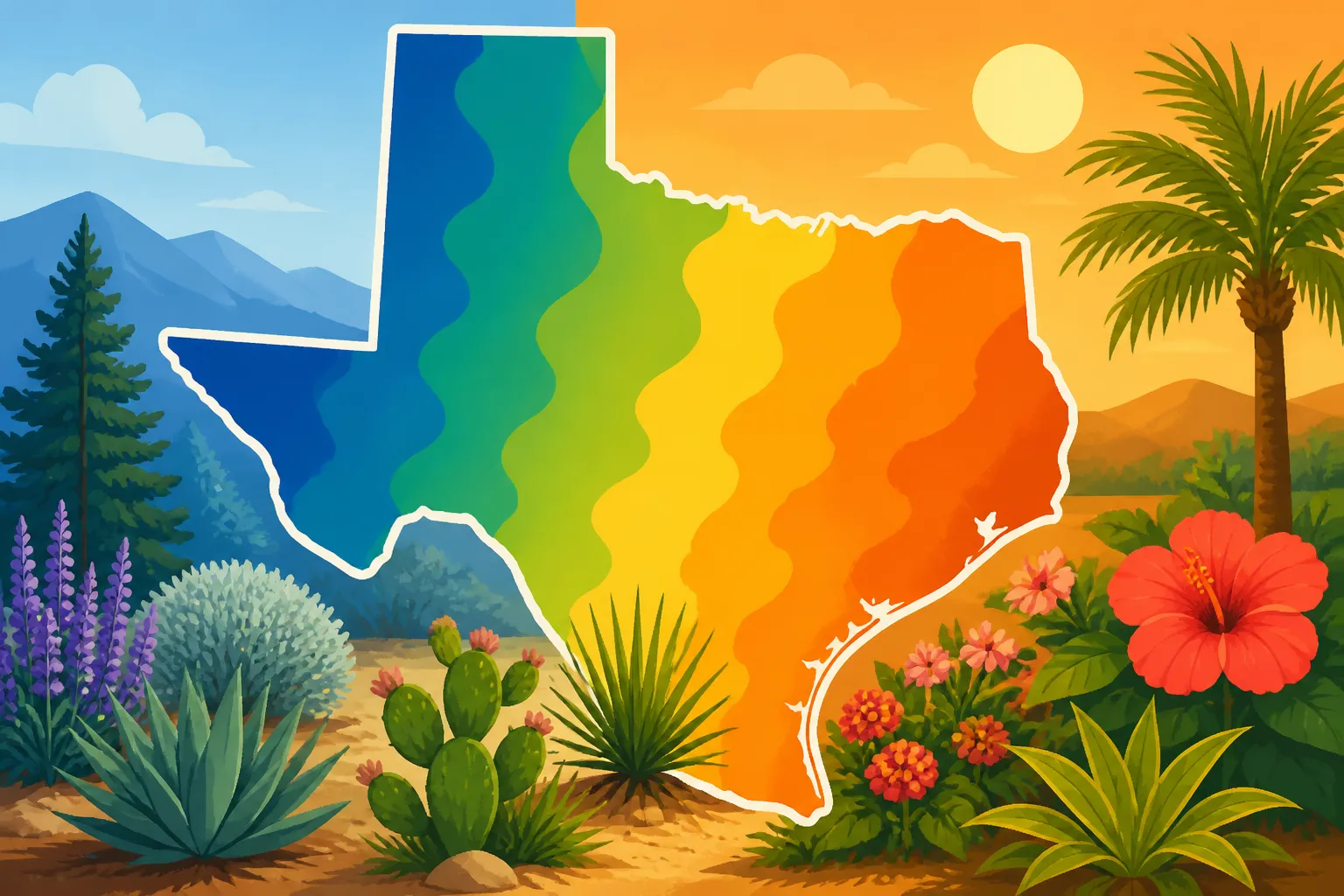
Texas stretches across a wide range of winter climates, so a plant that survives outdoors in one part of the state may struggle in another. The USDA Plant Hardiness Zone Map places Texas areas in zones 6b through 10b. Knowing what that range means helps you choose perennials and trees without mistaking a winter-survival guide for a planting calendar.
What USDA hardiness zones 6b through 10b mean
The USDA Plant Hardiness Zone Map groups locations by average annual extreme minimum winter temperature. In other words, it uses historical weather data to describe the coldest temperature a location is likely to experience in a typical year. It is designed to help gardeners compare the winter cold a perennial plant may need to tolerate.
The map divides the country into numbered zones, with each full zone covering a 10°F range. Each zone is further split into “a” and “b” half-zones, each covering 5°F. The Texas range in the title runs from zone 6b, with an average annual extreme minimum of -5°F to 0°F, to zone 10b, with an average annual extreme minimum of 35°F to 40°F.
That range describes differences in winter lows across a large state. It does not mean every spot within a zone will experience the same temperature each winter, or that an individual address has a guaranteed minimum. A zone is a long-term average, not a forecast. A colder-than-usual winter can still bring temperatures below the range associated with a location’s zone.
| USDA zone | Average annual extreme minimum | Broad gardening implication |
|---|---|---|
| 6b | -5°F to 0°F | Choose plants rated to tolerate colder winter lows |
| 7a | 0°F to 5°F | Winter cold remains an important selection factor |
| 7b | 5°F to 10°F | Check plant hardiness ratings and local exposure |
| 8a | 10°F to 15°F | Many plants still need consideration for occasional cold |
| 8b | 15°F to 20°F | A range of woody and perennial plants may be suitable |
| 9a | 20°F to 25°F | Winter cold risk is lower on average, but not absent |
| 9b | 25°F to 30°F | Tender plants may still be affected by unusual cold |
| 10a | 30°F to 35°F | Check whether a plant can handle local cold snaps |
| 10b | 35°F to 40°F | The map indicates a mild average winter minimum |
These figures are useful for comparing winter hardiness, but they do not describe everything a plant needs. A tree may tolerate the low temperatures associated with a zone and still fail in a poorly drained planting site, intense summer heat, or a dry spell. Likewise, a perennial’s ability to survive winter does not guarantee that it will flower well or thrive in the soil and sunlight in your yard.
For more background on the map and the statewide pattern, see Texas Hardiness Zones: Winter Lows from the Panhandle to the Coast. If you need the zone for a particular area, USDA Plant Hardiness Zones in Texas: Looking Up Your Zone by ZIP Code explains how to use a ZIP code as a starting point. ZIP codes cover broad areas, however, so treat the result as guidance rather than a precise measurement of your garden.
Why Texas has such a wide range of zones
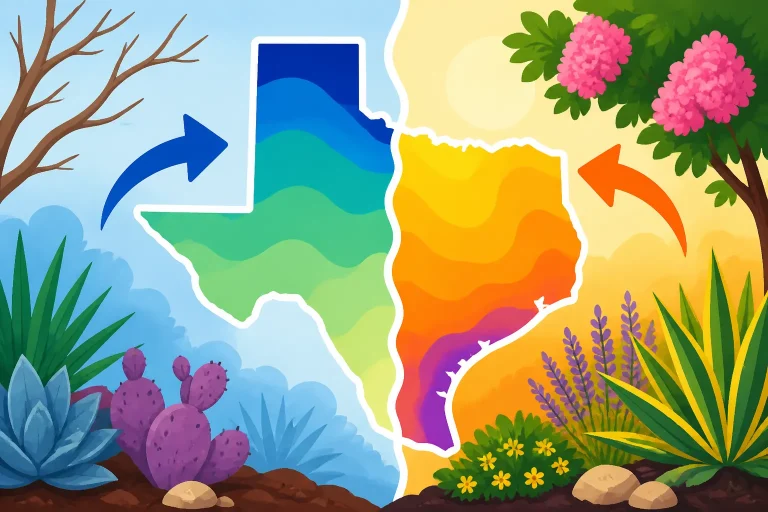
Texas covers a large area, and winter conditions vary across it. The north-to-south span is a major factor: the state’s northern areas generally face colder winter lows than its warmer southern areas. Distance from the Gulf, elevation, terrain, and local exposure also affect winter conditions. Together, these differences help explain why the state includes areas mapped from zone 6b through zone 10b.
A statewide zone range is useful for describing the overall spread, but it cannot stand in for a local lookup. Two gardeners in the same broad region—or even in nearby neighborhoods—can have different growing conditions. One yard might sit in an exposed, low-lying spot where cold air gathers. Another may have a sheltered planting area beside a building or under a mature canopy. Those differences can affect whether a particular plant survives a cold snap.
Regions are a starting point, not a substitute for checking
It can be tempting to think of the northern, central, and southern parts of Texas as neat bands on a map. In practice, zone boundaries do not follow simple lines that make every yard in a named region identical. The map is best used to narrow down possible plant choices, then checked against the conditions at the planting site.
When comparing plants for a Texas yard, consider:
- Your mapped location: Use the current USDA Plant Hardiness Zone Map or a ZIP-code lookup to identify the zone that covers your area.
- The exact planting spot: Note whether it is exposed to wind, shaded, near a warm building, or at a low point where cold air can settle.
- The plant’s rating: Check the plant’s stated hardiness range and whether it applies to a mature plant, young plant, or both.
- Local cold history: Think about cold snaps you have observed, without assuming that past weather sets a limit on future winters.
- Other site conditions: Soil drainage, sun, moisture, and summer heat can be just as important as winter cold.
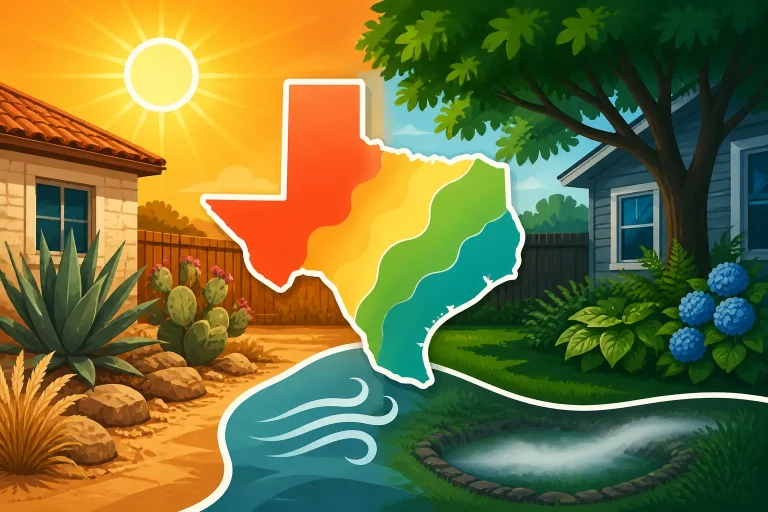
Local conditions can make the yard warmer or colder than a broad map suggests. A protected courtyard might experience less exposure to cold wind than an open garden, while a frost pocket can be colder than a nearby slope. These small-scale effects are called microclimates. They do not change the zone shown on the map, but they can change how reliably a plant performs in a particular spot. Why Yard Microclimates May Defy Your Texas USDA Zone covers these local differences in more detail.
Coastal influence does not remove cold risk
Areas nearer the Gulf can have milder winter conditions than some inland locations, but a mild average does not rule out a freeze. Gardeners should avoid choosing a tender plant on the assumption that a coastal location never gets cold enough to cause damage. Winter temperatures can vary from year to year, and a short cold event can injure a plant that normally grows well in a warm climate.
For the same reason, a plant’s ability to survive in one protected spot does not prove it will be hardy throughout a county or coastal region. Use the mapped zone to screen plants, then account for local conditions and be prepared for occasional weather outside the average. If you garden along the coast, Gulf Coast Hardiness Zones: Understanding Local Winter Temperatures can help put the regional pattern into context.
What a hardiness zone can—and cannot—tell you
A hardiness zone is most useful when choosing perennial plants: those expected to live through more than one growing season. That includes many trees, shrubs, and herbaceous perennials. If a plant is rated for winters colder than the typical minimum in your area, it may be a reasonable candidate from a cold-tolerance perspective. The rating is not a guarantee of success, because the plant still has to suit your soil, sunlight, water, and other conditions.
A zone can also help you compare varieties of the same type of plant. If one variety is rated for colder conditions than another, that difference can matter in a part of Texas where winter lows vary or where your yard is exposed to cold. Ratings should still be checked alongside local recommendations and the plant’s other growing requirements.
A hardiness zone does not tell you:
- The date of the last spring frost or first fall freeze.
- How long your frost-free growing period will be.
- When to sow seeds or transplant vegetables.
- Whether a warm-season crop has enough time to mature.
- How hot or humid summer will be.
- Whether a plant can tolerate drought, saturated soil, wind, or intense sun.
- Whether a tender plant will survive a rare cold snap.
- Whether a plant will flower or fruit well in your yard.
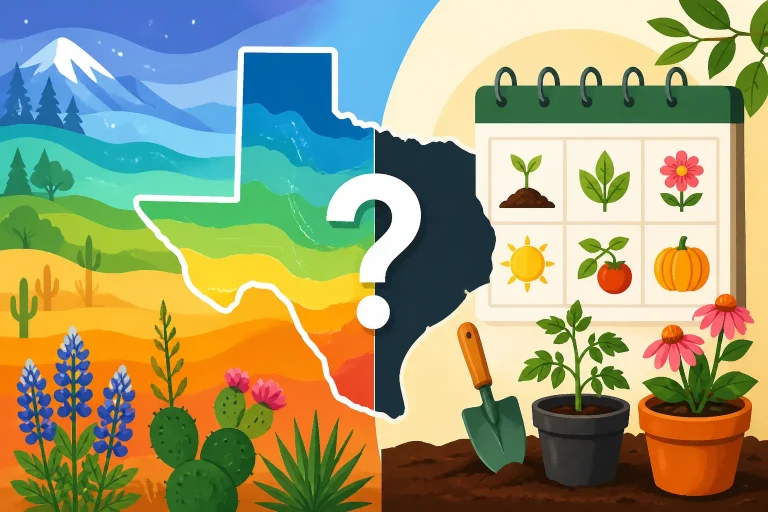
The most common calendar mistake is treating a zone as a planting date. A zone describes average winter cold, not the full seasonal pattern. It cannot tell you whether your soil is warm enough to sow a crop, whether a late spring frost is still possible, or whether a fall planting has enough time to mature. For those decisions, look at regional planting windows and local freeze information. Does a Hardiness Zone Set Your Planting Calendar? explains why winter zones and garden timing answer different questions.
Frost and freeze dates are also estimates based on weather records, not fixed annual deadlines. The risk of cold does not disappear on a single calendar date. A garden’s exposure, local terrain, and the weather in a particular year can all affect when a damaging cold event occurs. For a closer look at how those probabilities fit into planting decisions, see Spring and Fall Freeze Probability Milestones for Texas Gardeners.
How to use the 6b–10b range when choosing plants
The statewide range is useful as a reminder to shop and plan for your local climate, not for Texas as a single uniform growing zone. A plant selected for the warmest mapped conditions may not tolerate the winters in a colder area. Conversely, a plant chosen only for the coldest part of the state may be needlessly limiting in a warmer location. Starting with your local zone helps narrow the choices without asking one statewide list to fit every garden.
Use this process when selecting a tree, shrub, or perennial:
- Look up the zone for your area. Use the USDA map or a ZIP-code lookup. If the result seems surprising, compare it with nearby map areas and consider that a ZIP code is not a yard-level reading.
- Check the plant’s cold-hardiness range. Confirm that the plant is rated to tolerate the winter minimum associated with your location. Pay attention to whether the listing distinguishes between mature and young plants.
- Check requirements beyond hardiness. Look at the plant’s needs for sun, soil, drainage, moisture, and summer conditions. A suitable zone rating does not make a poor site suitable.
- Assess the planting spot. Identify areas where cold air may collect, where wind reaches the plant, or where nearby structures provide shelter. Use the most exposed or most vulnerable site conditions when deciding how much winter protection may be needed.
- Plan for variability. A plant that is near the edge of its recommended range can be more vulnerable to an unusually cold winter. Decide whether you are comfortable with that risk or would rather choose a plant with a wider cold-tolerance margin.
Container plants need an extra check. Their roots are surrounded by a limited amount of potting mix and are more exposed to cold than roots in the ground. A plant that is hardy in an in-ground garden may need protection or a sheltered location when grown in a pot. The container’s size and material, where it sits, and the conditions during a cold snap can all influence root exposure. For specific practical steps, see Protecting Potted Plants from Texas Freezes: When to Move or Cover.
Young plants also deserve attention. A newly planted tree or shrub may not yet have the established root system of a mature plant, and a recent transplant can be vulnerable while it settles in. A plant’s zone rating does not account for how recently it was planted or how well it has established. Check care guidance for the species and respond to local weather risks rather than assuming that the rating alone is enough.
Match the calendar to the crop, not the zone label
For vegetables and annual flowers, the local growing season and crop requirements are usually more useful than the hardiness zone alone. Cool-season crops and heat-loving crops have different temperature needs. A warm zone does not automatically make it a good time to plant a cool-season vegetable, and a colder zone does not tell you the exact date to start a crop indoors or outdoors.
Build a planting calendar around three practical questions:
- What temperatures does the crop prefer? Check whether it grows best in cool or warm conditions.
- How much time does it need? Compare its days to maturity with the season you expect, allowing for slower growth in less favorable weather.
- What local weather risks remain? Consider spring frost, fall freezes, summer heat, and sudden swings rather than relying on a single zone number.
Texas gardeners often plan for more than one growing window. In many areas, severe summer heat can interrupt production for crops that perform better in cooler weather. A calendar that works in one part of the state may need adjustments elsewhere, even if the gardeners are growing the same vegetables. Texas Spring and Fall Planting Windows by Region and Planning a Texas Vegetable Garden for Two Growing Seasons offer ways to think about those seasonal differences.
The distinction matters for fruit trees, too. A tree may be winter-hardy enough for a location yet produce poorly if it does not receive the winter chill it needs, blooms at a vulnerable time, or encounters a damaging late freeze. Hardiness is only one part of matching a fruit tree to a site. Consider the tree’s chill needs, pollination requirements, regional fit, and exposure before planting it. Choosing the Right Fruit Trees for Your Texas County is a useful next step for that kind of decision.
Getting a more useful picture of your yard
A zone lookup is a practical first step, but it should be one part of a yard-specific plan. The more precisely you understand the planting site, the more confidently you can decide which plants are likely to survive and which calendar advice applies.
Start by noting where cold damage tends to occur. Low areas may collect cold air, while a slope or a spot close to a building may have a different exposure. Observe whether the yard is open to wind or protected by walls, fences, or mature plants. These observations do not replace the USDA zone, but they help you interpret it.
Keep basic records over time. Note when cold-sensitive plants show injury, whether damage occurs across the whole yard or only in one area, and which spots remain sheltered. Avoid treating one mild winter or one severe cold event as proof that the yard’s climate has permanently changed. The point is to learn the range of conditions your garden may face, not to assign an exact minimum temperature to every bed.
For planting dates, use information designed for planting dates. Regional calendars, crop-specific guidance, and local weather forecasts are more appropriate than hardiness zones for deciding when to sow or transplant. A calendar should also be flexible: delay planting when conditions are unsuitable, and protect vulnerable plants when a forecast signals a cold event.
When a plant is borderline for your mapped zone, consider whether the site can reduce risk. A sheltered location may improve its chances, but it cannot reliably overcome a major mismatch between the plant’s cold tolerance and the local climate. If losing the plant would be costly or disappointing, choose a more cold-hardy option or plan for the possibility of winter protection. Frost and Freeze Protection Strategies for Texas Landscapes explains approaches for protecting plants when cold weather threatens.
The practical takeaway is straightforward: the 6b-to-10b span shows why Texas gardeners need local information. Use the zone to compare plants’ ability to tolerate winter cold. Use regional calendars and freeze-risk information to time planting. Then adjust both choices for the actual conditions in your yard.
Frequently Asked Questions
Does every Texas garden fall neatly into one hardiness zone?
The map assigns zones to geographic areas, but a ZIP-code result is not an exact reading for every yard. Local terrain, exposure, and nearby structures can create warmer or colder microclimates within the mapped area.
Does zone 10b mean a freeze is impossible?
No. A hardiness zone describes an average annual extreme minimum, not a guarantee about future weather. A location mapped in a warm zone can still experience an unusual cold event.
Can I use my zone to decide when to plant vegetables?
Not by itself. Zones describe winter cold tolerance, while vegetable planting depends on factors such as crop temperature preferences, maturity time, frost risk, and seasonal heat. Use a regional planting calendar for timing.
Should I choose plants for the warmest or coldest Texas zone?
Choose plants for the area where you garden, not for the statewide range. Look up your local zone, then consider the specific site and the plant’s needs beyond winter cold tolerance.
Disclaimer
This article is for general informational purposes only and does not constitute professional advice. Laws, prices and regulations vary by location and change over time. Consult a qualified professional for guidance on your specific situation. Texas Gardening Hub is not a government agency and is not affiliated with any university extension, state department of agriculture or other government agency.