USDA Plant Hardiness Zones in Texas: Looking Up Your Zone by ZIP Code
A ZIP code can point you toward a USDA Plant Hardiness Zone, but it cannot describe every temperature condition in your yard. Texas spans a wide range of winter climates, and even nearby sites can differ. Here’s how to look up your mapped zone, check whether the result fits your location, and use it without mistaking it for a planting calendar.
What a USDA Plant Hardiness Zone Measures
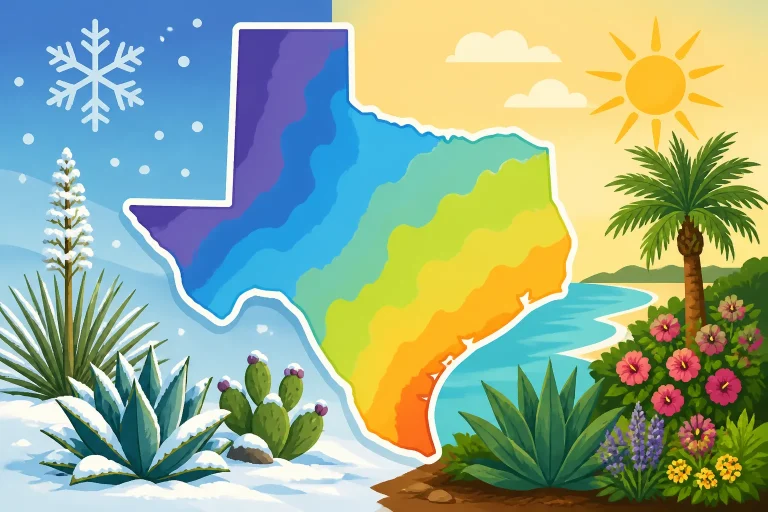
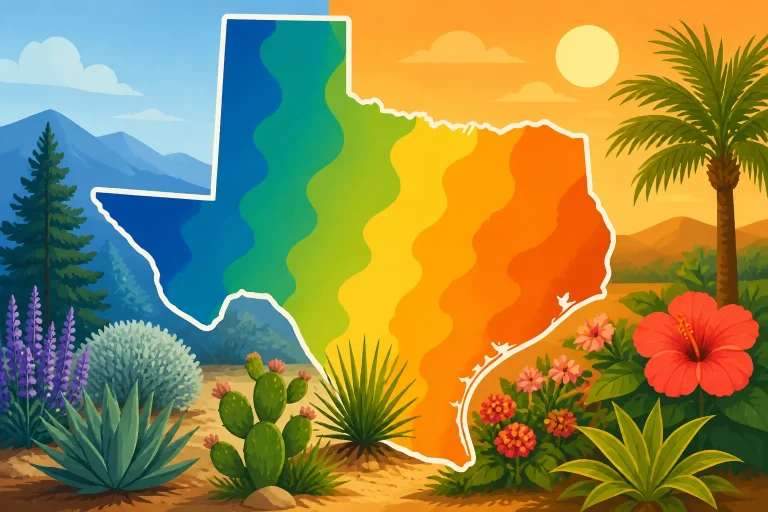
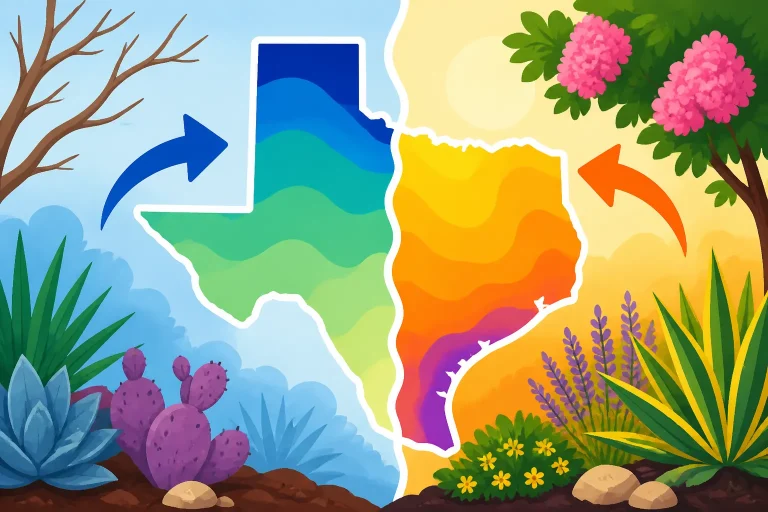
A USDA Plant Hardiness Zone describes a place’s average annual extreme minimum winter temperature. The map groups locations into zones and half-zones according to those winter lows. Texas includes mapped areas from Zone 6b through Zone 10b, but your ZIP code alone does not establish the zone for a particular home or garden.
The zone is a useful reference when comparing plants’ ability to tolerate winter cold. A plant labeled hardy in a particular zone is generally expected to withstand the winter minimums associated with that zone, assuming it is established and growing under suitable conditions. The label is not a guarantee: soil, drainage, wind, plant age, exposure, and the duration and timing of a cold spell can all affect survival.
A hardiness zone is based on an average of extreme minimum temperatures over a period of years. It is not the coldest temperature ever recorded, nor a promise about the coldest temperature in the coming winter. A location may experience a colder or warmer winter than its long-term average. For that reason, it is better to treat a zone as a planning baseline than as a precise forecast.
The letter after the zone number adds another level of detail. Each numbered zone is divided into “a” and “b” half-zones. These represent smaller temperature bands within the larger zone. The half-zone can help distinguish locations near a boundary, but it does not make the map exact at the scale of an individual garden bed.
The USDA Plant Hardiness Zone Map is also not a measure of summer heat. Two Texas locations in the same zone can have different summer temperatures, humidity, rainfall, soil conditions, and lengths of hot weather. Those differences matter for plant growth and garden timing, even when the winter-zone rating is the same.
| Question | What the USDA zone can help answer | What it cannot answer by itself |
|---|---|---|
| Will a perennial or shrub likely tolerate typical winter cold here? | Whether its listed hardiness range is broadly compatible with the location | Whether it will thrive in the site’s soil, sun, drainage, or summer heat |
| When should spring seeds be sown? | Very little on its own | When the last spring frost is likely, whether soil is warm enough, or when heat will arrive |
| Can a fruit tree produce reliably? | Whether winter cold may be within its broad tolerance range | Whether it receives enough winter chill, avoids spring freezes, or has suitable pollination |
| Is a plant safe from a freeze? | Whether its general winter hardiness may fit the area | Whether it can withstand a specific cold snap or a freeze at a vulnerable growth stage |
| Is one yard warmer than another? | A broad regional comparison | Small differences caused by slopes, walls, pavement, shade, or cold-air drainage |
To understand the map’s role in planting decisions, it helps to separate three questions: what winter minimums are typical, when frost and freezes tend to occur, and what conditions a particular plant needs. The zone mainly addresses the first question. For a broader view of Texas winter lows, see Texas Hardiness Zones: Winter Lows from the Panhandle to the Coast.
How to Look Up a Texas Zone by ZIP Code
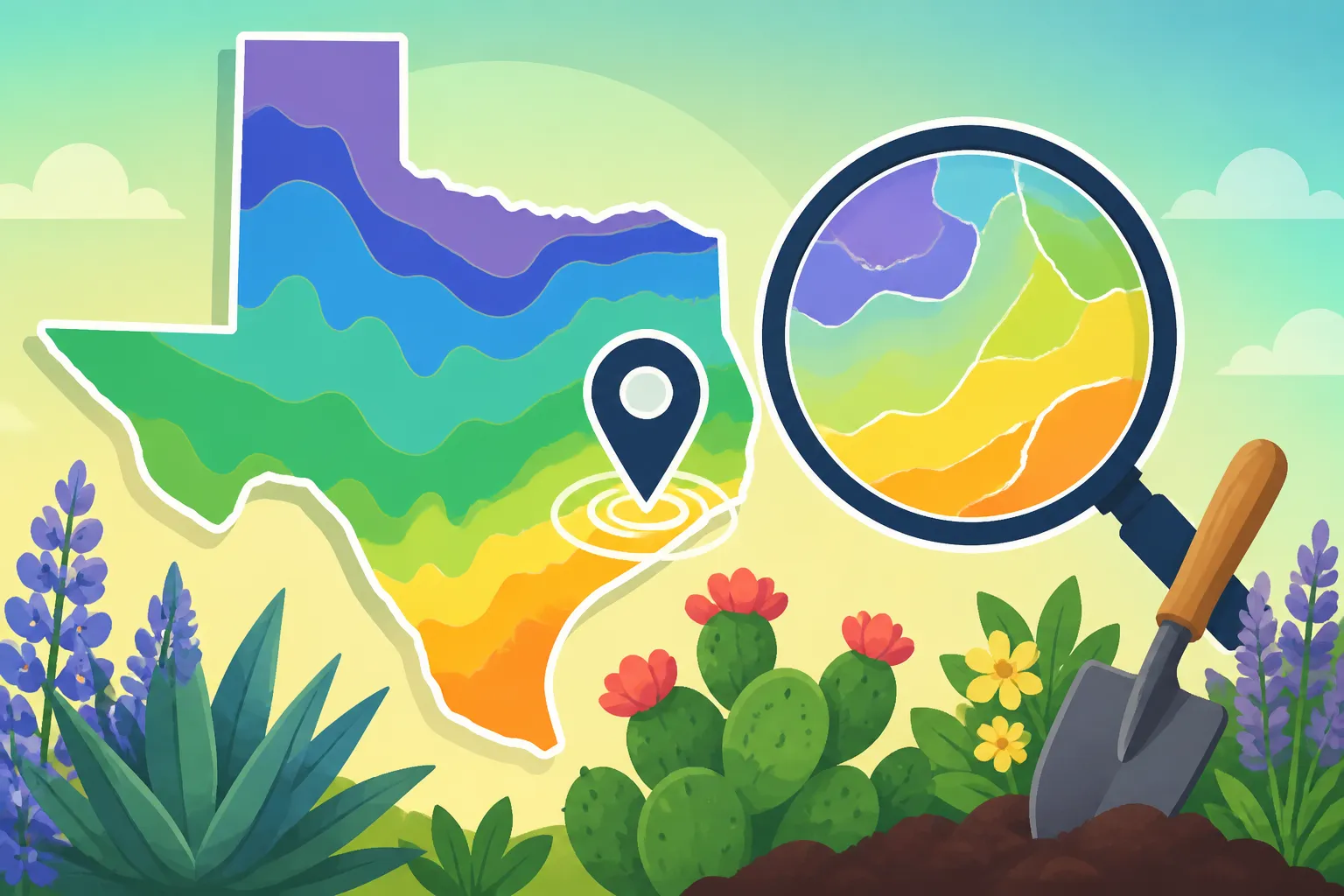
The USDA Plant Hardiness Zone Map provides an official starting point. Its interactive map allows users to search for a location, including by ZIP code. Use it to identify the mapped zone around the place you intend to garden, then inspect the map rather than treating the search result as a yard-level reading.
- Open the official USDA Plant Hardiness Zone Map. Search for the map through the USDA website so you are using the official map rather than a third-party summary or a screenshot that may show an older version.
- Enter your ZIP code in the map’s location search. The result should take you to the general area associated with that ZIP code. A ZIP code is a useful way to get oriented, not a guarantee that the entire ZIP area shares one zone.
- Zoom in and inspect the colors around your location. Look for zone boundaries near the neighborhood, town, or site where you garden. If the location is close to a boundary, note both nearby zones rather than assuming that the search result settles the question.
- Check the map legend. Confirm the number and half-zone shown by the map. A zone number without its “a” or “b” designation may leave out useful detail.
- Compare the map result with your own records. Local winter observations can show whether your particular site tends to be warmer or colder than the broad map suggests. A few years of notes help identify patterns, but they do not replace the long-term map data.
- Use the result as one factor in plant selection. Check the plant’s hardiness range and consider local soil, sun, water, summer heat, and exposure before deciding where it belongs.
A ZIP code may cover a broad area, and the map’s color can change within a ZIP area or near its edges. The search function is there to help you find the right region on the map; it is not a measurement taken from your garden. If you are near a zone boundary, use the map’s detailed view to see where the boundary lies in relation to your location.
Be careful when looking at printed maps, nursery labels, search results, or older online articles. A zone value may come from a different map edition, or the source may round a half-zone to a full zone. When the exact designation affects a purchase, compare it with the current official map.
The map does not assign a zone to a specific address. Even a detailed zoom level cannot account for every yard feature or prove that a particular plant will survive. Use the mapped result to narrow your options, then judge the planting site and the plant’s needs.
If you are trying to plan vegetables rather than choose a perennial or tree, a zone lookup is only a starting point. A planting calendar uses seasonal frost risk, crop preferences, and heat as well as winter hardiness. Texas Vegetable Planting Guide: Matching Crops to Your Region can help connect those factors to regional vegetable timing.
How to Read the Result and Handle Nearby Zone Boundaries
The search result is easiest to use when you read it as a regional classification rather than a precise prediction. Suppose a location appears in a half-zone on the map. That label summarizes long-term winter minimum patterns for the mapped area. It does not mean that every garden within that color experiences the same temperatures every year.
Start by recording the full zone designation, including the letter. If a plant label lists a range, compare the complete range with the map result. A plant rated for colder conditions may be a reasonable candidate in a warmer zone, but that alone does not mean it suits the site. A plant’s upper temperature tolerance, water requirements, soil preferences, and response to summer heat may matter just as much.
If your ZIP code falls near a boundary, avoid making a decision based on a single search result. The mapped border may pass close to your neighborhood, and the search pin or center of the ZIP area may not be located where you garden. Inspect the surroundings on the map and consider how your site compares with the general landscape. A low, exposed location may behave differently from a sheltered location a short distance away.
When two sources give different answers, check how each source identifies the place and which map it uses. One source may use a ZIP-code center, while another may refer to a nearby weather location or a different map edition. Those are not necessarily equivalent comparisons. The current USDA map is the appropriate reference for the USDA zone; local weather observations can provide additional context, not a replacement designation.
It can also help to distinguish an official mapped zone from a personal rule of thumb. A gardener may describe a yard as “warmer than the map” because tender plants often survive there, or “colder than the map” because a low spot repeatedly freezes. That observation can be useful for making cautious choices, but it does not change the official zone shown on the map.
For plants that are expensive, slow-growing, or difficult to replace, consider the risk of planting near the edge of the plant’s listed range. A plant’s label is not a warranty, and a rare severe winter can cause damage beyond what average conditions would suggest. A sheltered site may improve the odds, while exposure to wind, poor drainage, or a cold-air pocket may make them worse.
A practical approach is to treat a boundary as a reason to be conservative. Choose plants with a hardiness range that includes your mapped zone, and give more tender selections a site with favorable exposure and drainage. If losing a plant would be costly or disappointing, avoid relying on a narrow difference between adjacent half-zones as the deciding factor.
What a Hardiness Zone Can and Cannot Tell You
The most reliable use of a hardiness zone is screening plants for general winter tolerance. It can help you compare labels and eliminate choices that are unlikely to handle typical winter lows in your region. It is especially useful when evaluating landscape trees, shrubs, and perennials that remain outdoors from year to year.
But winter hardiness is only one piece of plant suitability. A plant may tolerate the minimum temperature associated with a zone and still struggle because its roots sit in waterlogged soil, its leaves face intense afternoon sun, or it lacks enough moisture during a hot spell. Plants that are hardy across much of Texas may still need different care in different soils and exposures.
| Planting question | Better information to use alongside the zone |
|---|---|
| Can a tree or perennial overwinter outdoors? | The plant’s full hardiness range, site exposure, drainage, and establishment needs |
| When to sow a spring vegetable? | Regional planting windows, frost probability, soil temperature, and crop maturity |
| When to protect blooms or new shoots? | The forecast, current plant stage, and the crop’s or plant’s cold sensitivity |
| Will a fruit tree set fruit? | Winter chill needs, pollination, flowering time, and spring freeze risk |
| Will a container plant survive winter outside? | The plant’s hardiness, pot exposure, root insulation, and the expected cold conditions |
A zone is not a frost-date calculator. The last spring frost and first fall frost are separate seasonal probabilities, and they vary from year to year. A plant that can survive the region’s typical winter may still be damaged if tender growth appears before a late cold spell. Conversely, a frost-sensitive vegetable may be grown successfully during a long warm season even if its hardiness classification would not describe it as winter hardy.
For vegetables, the planting window often depends on when a crop can grow well, not on whether it can survive the lowest winter temperature. Cool-season vegetables may need to establish and mature before heat sets in. Warm-season vegetables need sufficiently warm conditions and may be harmed by cold soil or a late freeze. The zone alone does not identify those windows. See Why USDA Zones Miss Frost Dates for Spring Seeds for the distinction between hardiness ratings and frost timing.
Zones do not measure summer heat either. A perennial that overwinters easily can still suffer when high temperatures, dry soil, or intense sun outpace its ability to take up water. Heat tolerance and drought tolerance are different traits, and neither is implied by a winter-zone label. When selecting landscape plants, match the plant to both the winter and summer conditions of the site.
Fruit trees illustrate the limits particularly well. A tree may be hardy enough to survive winter but need a certain amount of winter chill to flower and fruit well. It may also bloom early enough for a spring freeze to damage flowers or young fruit. Those are different concerns from whether the trunk and roots survive a typical winter low. For that reason, combine zone information with local fruit-tree guidance rather than choosing a tree by hardiness label alone.
The same caution applies to container plants. Roots in a pot can be more exposed to cold than roots in the ground, and a pot may be in a windy or elevated position. A plant that is usually hardy in the ground may need a more protected location in a container. Protecting Potted Plants from Texas Freezes: When to Move or Cover discusses how container exposure changes freeze risk.
Use the Zone as One Part of a Texas Planting Plan
A useful planting decision combines the zone with the plant’s purpose and the local growing season. For a landscape shrub, ask whether it can tolerate winter lows, whether its mature size fits the bed, and whether it suits the soil and available light. For a vegetable, ask when it grows best, how much time it needs to mature, and whether the weather is likely to shift into heat or cold before harvest.
The order of those questions matters. If you are selecting a permanent tree or shrub, winter hardiness is an important early filter. If you are scheduling a bed of vegetables, start with regional planting windows and use the zone only as background information. A vegetable calendar addresses seasonal timing more directly than a hardiness map.
For annual flowers, an outdoor planting date may be constrained by the likelihood of frost, cold soil, or heat, depending on the plant and season. A plant’s hardiness information may tell you whether it can persist through winter, but many annuals are planted for one season and are chosen for their expected performance during that season. For perennials, the zone may be more useful for winter survival, but it still cannot guarantee the plant will thrive in the chosen location.
A simple decision process can prevent a zone label from doing too much work:
- Identify what you are planting. A tree, perennial, annual flower, vegetable, and potted herb have different planning questions.
- Check the full hardiness range. Use the USDA zone to screen for winter tolerance, including the half-zone if available.
- Check the seasonal window. For edible crops and seasonal flowers, use a regional calendar and consider frost risk, temperature, and days to maturity.
- Match the site. Consider sun exposure, soil texture, drainage, wind, available water, and nearby pavement or structures.
- Consider local variation. Note whether the planting site is exposed, sheltered, elevated, or in a low area where cold air collects.
- Plan for uncertainty. If the plant is near the edge of its range or the timing is close to a freeze, have a backup plan or choose a more resilient option.
For edible gardens, Texas’s regional differences make it especially important not to treat one zone as a statewide planting schedule. A planting window suitable in one part of the state may not suit another because seasonal heat and freeze timing differ. Texas Spring and Fall Planting Windows by Region is a better next step when you need to time crops, while Does a Hardiness Zone Set Your Planting Calendar? explains why the two tools answer different questions.
Gardeners can also keep a short record of planting dates, freezes, and plant performance. Note the location of a bed, whether it is sheltered, and whether cold damage occurred. These observations do not create a new official zone, but they can make future decisions more practical. For example, repeated damage in one exposed bed may suggest moving a tender plant to a more protected site rather than changing the zone used for the whole property.
If you are starting a garden from scratch, choose the type of garden and its location before relying on a zone result. A sunny bed near a water source may work well for many vegetables, while a shaded, poorly drained area may not. For help designing a practical vegetable space, see How to Plan a Vegetable Garden Layout Your Family Will Eat. If the garden is focused on long-lived landscape plants, Matching Texas Native Plants to Your Ecoregion and Soil Type offers a way to consider regional conditions beyond winter hardiness.
Account for Yard Microclimates and Local Freeze Risk
A map describes broad patterns. A yard contains smaller conditions shaped by terrain, structures, tree cover, paving, wind exposure, and drainage. Those differences are called microclimates. They can affect whether a plant experiences a particular cold night, how quickly soil warms in spring, and how much heat or drying stress it receives in summer.
Cold air tends to move downhill and settle in lower spots, especially when conditions are calm. A low corner of a yard may experience colder temperatures than nearby higher ground. A slope with good cold-air drainage may be less exposed to a frost pocket, although wind and other site features can change the result. If plants in one part of the yard repeatedly show more cold damage than plants elsewhere, note that pattern when selecting or placing future plants.
Walls, fences, and buildings can create shelter from wind, and nearby pavement may store heat and release it later. These effects are local and variable. A sheltered corner can help a plant, but it can also receive reflected heat or have limited airflow. A warm wall should not be treated as proof that a tender plant is safe during a severe freeze.
Tree canopy can reduce exposure to radiative cooling on some nights, while dense shade may affect the plant’s light and moisture conditions in other ways. Overhangs can protect plants from some weather exposure but may also reduce rainfall reaching the soil. The right location depends on the plant’s needs as well as the cold pattern.
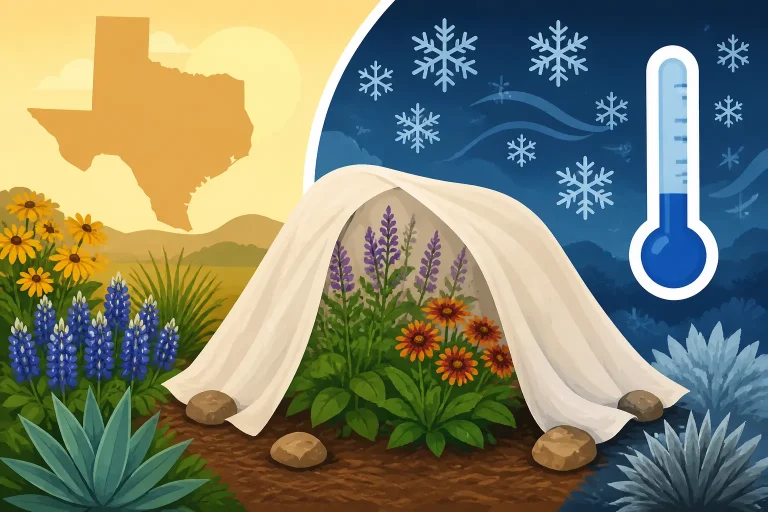
Pots deserve separate attention. Their roots are surrounded by a relatively small volume of growing medium and are exposed on more sides than roots in the ground. A pot on an elevated deck or a windy patio may face conditions unlike a planted bed in the same yard. Moving pots to a protected area or grouping them can change their exposure, but the appropriate action depends on the plant and the forecast. The mapped zone alone cannot determine when a pot needs protection.
Local weather observations help refine decisions. Pay attention to the forecast during freeze events, but remember that an outdoor weather station may not match the temperature in your yard. A station near an airport, for instance, may differ from a sheltered residential lot or a low-lying garden. Do Airport Weather Station Freeze Dates Match Your Yard? explains why station information and yard conditions may not line up exactly.
A useful record can include the date of a freeze, the minimum temperature reported by a nearby station, the location of vulnerable plants, and any visible damage. Over time, this can help you distinguish a general regional pattern from a recurring problem spot. Avoid drawing a strong conclusion from a single winter: one unusual cold event does not redefine a long-term hardiness zone.
For freeze timing, use probability-based information rather than treating a single average date as a guarantee. A frost or freeze date is an estimate, not a fixed annual deadline. Check current forecasts when tender plants are exposed to a possible cold snap, and use regional norms to plan ahead. Freeze Risk and Growing Season Length Across Texas Regions can help put the broader seasonal risk in context.
Microclimate awareness does not replace the USDA map. It helps translate a broad regional rating into a more realistic planting choice for a specific bed or container. When a plant is marginally hardy, choosing a protected site and monitoring cold forecasts can improve its chances, but neither action removes the risk of an unusually severe winter.
Frequently Asked Questions
Can I get my exact Texas hardiness zone from a ZIP code?
A ZIP code can help locate the general area on the USDA map, but it does not establish an exact zone for every address within it. Zoom in, check nearby boundaries, and treat the result as a regional reference.
Does my hardiness zone change from year to year?
A mapped zone is based on long-term winter temperature patterns, not the weather of one season. Individual winters vary. Map editions may also be updated, so consult the current official map when checking your designation.
Should I plant vegetables according to my USDA zone?
Not by itself. Use a regional vegetable calendar and consider frost risk, soil and air temperatures, crop maturity, and approaching heat. The zone is mainly a broad guide to winter cold tolerance.
Does a warmer zone mean a plant will thrive in my yard?
No. The zone can help screen for winter hardiness, but it does not describe summer heat, soil, drainage, sunlight, water needs, or local freeze pockets. Match the plant to the whole site.
Disclaimer
This article is for general informational purposes only and does not constitute professional advice. Laws, prices and regulations vary by location and change over time. Consult a qualified professional for guidance on your specific situation. Texas Gardening Hub is not a government agency and is not affiliated with any university extension, state department of agriculture or other government agency.