Texas Hardiness Zones: Winter Lows from the Panhandle to the Coast
Choosing plants for Texas can be confusing: a variety may thrive in one part of the state and struggle through winter in another. Hardiness zones help compare winter cold across locations, but they are only one piece of the planting decision. Here’s how to use the zone range—from 6b to 10b—without mistaking it for a full planting calendar or a guarantee.
What a Hardiness Zone Measures
The USDA Plant Hardiness Zone Map groups places by their average annual extreme minimum winter temperature. In other words, it estimates the coldest temperature a location typically reaches in an average year, based on a long-term record. It does not show the average winter temperature, the length of winter, or the coldest temperature a place could ever experience.
Each numbered zone spans a 10°F range. The “a” and “b” letters divide that range into two 5°F half-zones. For Texas, the range runs from zone 6b to zone 10b. The corresponding temperature bands are:
| Zone | Average annual extreme minimum temperature |
|---|---|
| 6b | -5°F to 0°F |
| 7a | 0°F to 5°F |
| 7b | 5°F to 10°F |
| 8a | 10°F to 15°F |
| 8b | 15°F to 20°F |
| 9a | 20°F to 25°F |
| 9b | 25°F to 30°F |
| 10a | 30°F to 35°F |
| 10b | 35°F to 40°F |
These bands describe averages, not boundaries that stop cold air. A garden in a warmer zone can still experience a colder-than-usual winter, and a garden in a cooler zone can have a mild one. A single severe cold snap does not necessarily change the zone, because the map is not a record of the lowest temperature ever observed.
A zone is best understood as a comparison tool. If a perennial is rated hardy to a particular zone, that rating gives a broad indication of whether it is likely to survive typical winter lows there. It does not promise that the plant will thrive, flower well, or come through every freeze without damage. Nor does a rating describe how much summer heat, humidity, drought, wind, wet soil, or disease a plant can tolerate.
The zone map also cannot tell you whether a plant will be harmed by a brief frost. Many plants are affected by temperatures above the winter lows used to define hardiness zones. Tender spring growth, blossoms, and fruit can be damaged during a late cold event even when the plant itself is hardy enough to survive the winter.
For a quick local check, use USDA Plant Hardiness Zones in Texas: Looking Up Your Zone by ZIP Code. A ZIP code is useful for finding a general area on the map, but it cannot account for every yard’s exposure, slope, or shelter. Treat the map result as a starting point, not a precise forecast for one planting bed.
How Texas Winter Lows Vary Across the State
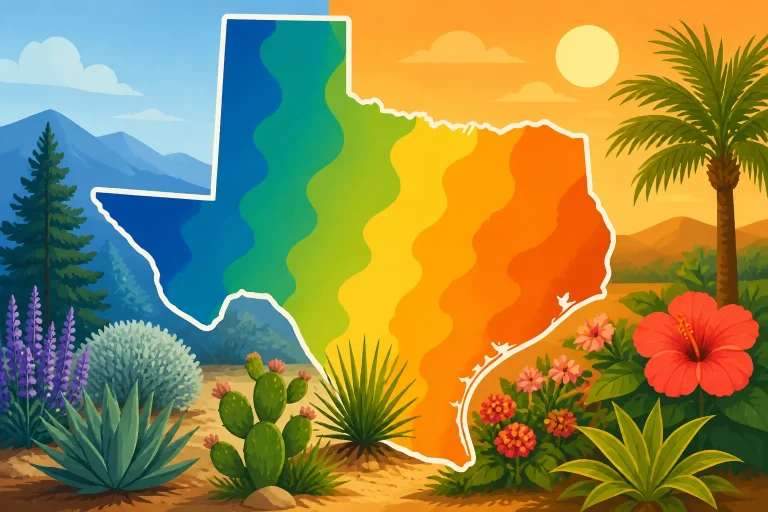
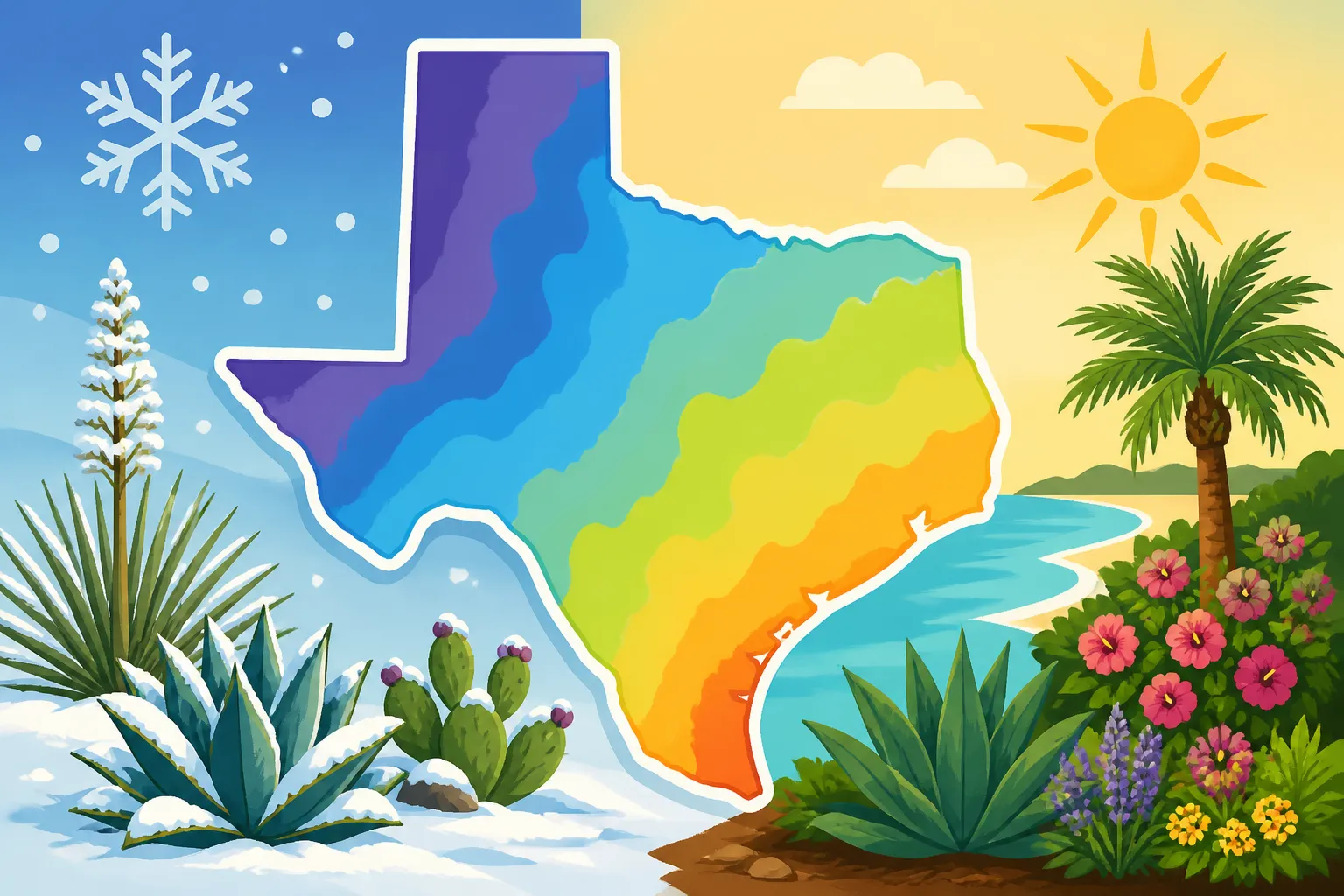
Texas spans a large area, and winter conditions vary as you move from the Panhandle toward the coast. The statewide range from 6b to 10b captures a broad contrast: some locations regularly experience colder winter lows than others. It does not mean that every location in a particular region shares one zone, or that zone boundaries follow county or city lines neatly.
In general, differences in distance from the coast, elevation, exposure to cold air, and local terrain all matter. The coastal influence can moderate winter temperatures in some places, while inland locations may be more exposed to sharp temperature swings. But regional shorthand can mislead. A sheltered yard and an exposed site in the same broad area may not experience identical cold, and conditions can differ across relatively short distances.
Topography is one reason a state-level description cannot replace a local map lookup. Cold air can settle in low areas, while a slope or elevated site may drain cold air more readily. Buildings, fences, tree cover, and paving can also affect how a planting area cools overnight. These factors may make a yard behave differently from the nearby weather station or the general zone shown for its ZIP code. Why Yard Microclimates May Defy Your Texas USDA Zone explains how to think about those small-scale differences.
A zone boundary should not be treated like a wall. Two neighboring locations on opposite sides of a mapped boundary might have very similar conditions, especially when their elevation and exposure are alike. Conversely, two gardens with the same zone label can differ because one sits in a cold pocket, faces strong winter winds, or gets more shelter from buildings and vegetation.
The map remains useful because it offers a consistent way to compare broad winter risk. When you are choosing a long-lived shrub or perennial, the zone can help you eliminate plants that are clearly too tender for the typical winter lows in your area. But the closer a plant’s hardiness rating is to the local zone boundary, the more important it is to consider the site and the plant’s other needs.
For this reason, avoid turning the statewide range into a set of rigid regional rules. The Panhandle-to-coast pattern helps explain why a single planting recommendation may not suit all Texas gardens. For a particular yard, use the map to identify its general zone, then check local gardening guidance and the plant’s requirements before buying.
Using Zones to Choose Plants
Hardiness zones are most helpful when you use them as an initial filter for plants that remain outdoors through winter. This is especially relevant for trees, shrubs, and perennial plants that you expect to return year after year. If a plant’s listed hardiness range includes your zone, it may be a reasonable candidate for winter survival, but that is only one part of whether it will do well in your garden.
Read the full plant description rather than relying on the zone number alone. A plant that tolerates winter cold may still need a different amount of sun, soil drainage, or moisture than your site provides. Some plants also have specific preferences for soil type or acidity. A plant can survive a winter and still grow poorly because its roots stay too wet, it receives too little light, or summer conditions exceed its tolerance.
Check whether the hardiness rating applies to the plant itself or to a particular cultivar. Different selections within a species can vary in cold tolerance and mature size. A nursery label or reliable plant reference may give a hardiness range, but descriptions can differ in how they present the information. When a plant’s rating is close to your zone, look for more detailed local recommendations rather than assuming the label settles the question.
Plant age and establishment can also affect winter performance. A newly planted specimen may be more vulnerable than an established one, especially if it has not had time to develop a strong root system. Container-grown plants face a related challenge: their roots are exposed to colder conditions than roots in the ground, and a pot can be affected by temperature fluctuations from several sides. If you are choosing plants for containers, consider both the plant’s hardiness and how you will protect the container during severe weather. See Protecting Potted Plants from Texas Freezes: When to Move or Cover for practical options.
The plant’s location within your yard matters, too. A sheltered site next to a building may offer some protection from wind, while a low spot may collect cold air. Shelter does not make a tender plant reliably hardy, but it can influence how much cold stress a plant experiences. Avoid relying on a particularly protected corner as proof that a marginal plant will survive everywhere else on the property.
A useful approach is to sort potential plants into three groups:
- Likely candidates: Their listed hardiness includes your zone, and their sun, soil, and water requirements fit your site.
- Possible but uncertain: Their cold rating is close to your zone, or the description offers limited detail. Consider your yard’s exposure and seek local guidance.
- Poor matches: Their listed hardiness is notably warmer than your zone, or their growing requirements conflict with your conditions.
This approach helps prevent a common mistake: treating a favorable zone match as a complete suitability test. A zone can help answer “Could this plant survive typical winter lows here?” It cannot answer “Will it be a good choice for this exact bed?” For broader help matching plants to site conditions, see Matching Texas Native Plants to Your Ecoregion and Soil Type and Choosing the Right Tree for Your Texas Yard and Soil.
Why a Hardiness Zone Is Not a Planting Calendar
Hardiness zones are about winter cold, not the best day to sow seeds or transplant vegetables. They do not provide the date of a typical last spring freeze, the date of a first fall freeze, or the number of frost-free days in a growing season. Those timing details matter when you are planning a vegetable garden, starting warm-season annuals, or protecting new growth.
A map zone cannot tell you whether the soil is warm enough for a particular crop. It does not account for a cold snap expected next week, a warm spell that encourages early growth, or summer heat that may shorten the harvest window. Two places in the same zone can have different planting opportunities because their frost timing, rainfall, and seasonal heat patterns differ.
That distinction is especially important for vegetables. Many crops are grown seasonally rather than kept outdoors year-round. Their success depends on planting windows, soil conditions, and how long they have to mature before heat or cold interferes. A winter hardiness rating for a perennial does not automatically translate into a sowing date for lettuce, beans, tomatoes, or other crops.
For timing decisions, use regional calendars and current weather conditions alongside the zone map. Does a Hardiness Zone Set Your Planting Calendar? explains why those tools answer different questions. For practical seasonal planning, see Texas Spring and Fall Planting Windows by Region and Texas Planting Schedules for Veggies and Flowers.
Freeze dates are also probabilities, not appointments. Historical averages can help describe the pattern, but an early or late freeze can happen. A calendar date should not be treated as a guarantee that tender plants are safe from cold. When deciding whether to plant, consider the forecast, the crop’s tolerance, and whether you can protect it if temperatures fall.
The same caution applies to spring planting. A warm spell can make a yard feel ready before cold risk has passed. A plant may begin growing and then be injured by a later freeze, even if it is normally hardy enough to survive winter while dormant. For seedlings and newly emerged growth, cold tolerance can be quite different from the plant’s ability to survive an established winter.
A simple way to keep the tools straight is:
| Gardening question | Best starting point |
|---|---|
| Could this tree or perennial tolerate typical winter lows here? | Hardiness zone and plant rating |
| When should I sow or transplant a crop? | Regional planting calendar and crop timing |
| Could a freeze damage plants this week? | Current forecast and plant sensitivity |
| Is this exact bed warmer or colder than the surrounding area? | Yard observation and microclimate assessment |
| Will the plant suit my soil, light, and water conditions? | Plant requirements and site evaluation |
A successful Texas planting plan combines these sources instead of asking the hardiness map to do every job. If you are planning both vegetables and landscape plants, use a zone to screen long-term winter survival, then use crop-specific timing information for the seasonal work.
Microclimates Can Shift the Risk in Your Yard
A hardiness map shows broad patterns. A yard contains smaller places that can be warmer, colder, windier, sunnier, shadier, or wetter than the surrounding area. Those differences are called microclimates, and they can affect how a plant experiences winter as well as heat and drought.
Start by noticing where cold seems to collect. Low points, enclosed corners, and places with little air movement may stay colder during some conditions. A slope can behave differently from a hollow. If you have seen frost linger in one part of the yard while another clears sooner, that is useful evidence when deciding where to place a sensitive plant.
Buildings and walls can influence temperature by blocking wind and changing how heat moves around a site. An overhang may reduce exposure to rain or radiated heat loss, while a nearby paved surface can warm during the day and release heat later. Trees and shrubs may offer shelter, but dense canopy can also reduce sunlight or compete for water. A protected position is not automatically ideal; it must still meet the plant’s light and moisture needs.
Containers create another distinct microclimate. The roots of a plant in a pot are less insulated by the ground than roots in a garden bed. A container on an exposed patio may be hit by wind and cold on all sides; a pot near a sheltered wall may face a different set of stresses. Consider the container’s material, size, location, and ability to move when choosing a plant for it. Protecting Texas Patio Pot Roots During Freezing Weather covers why the root environment matters.
Microclimates affect summer performance too. A bed beside a west-facing wall may receive intense afternoon heat, while a garden under a tree may have more shade and competing roots. These details can decide whether a plant that is hardy enough for winter can tolerate the rest of the year. Why USDA Zones Miss Frost Dates for Spring Seeds is a useful reminder that broad zone labels leave out important local and seasonal conditions.
You can learn about your yard through observation rather than guessing from a map. Keep simple notes about where frost appears first, where snow or ice lingers if it occurs, which areas are exposed to prevailing winds, and how sun reaches beds through the day. Record plant performance over time: where a shrub shows cold injury, where a perennial returns reliably, or where a container needs extra attention.
Use those observations to place plants thoughtfully. Put the most cold-sensitive choices in locations with suitable shelter, while keeping in mind that protection is not a substitute for a suitable hardiness rating. Avoid placing plants that need excellent drainage in a spot that stays wet, even if it is warmer. A favorable microclimate cannot compensate for every mismatch.
A Practical Process for Planning With the Map
A few deliberate steps can make hardiness-zone information more useful and reduce the chance of buying a plant that is poorly suited to your yard.
- Look up the general zone for your location. Use the USDA map and a ZIP code as a starting point. Remember that a ZIP code covers an area, not a specific planting bed. For more on interpreting the result, use USDA Plant Hardiness Zones in Texas: Looking Up Your Zone by ZIP Code.
- Identify what you are planting. A long-lived tree or shrub raises a different winter-survival question from a seasonal vegetable. Confirm whether you want the plant to survive outdoors year after year or are growing it for one season.
- Check the plant’s hardiness range. Look for the stated cold tolerance and note whether your zone falls within it. If the plant is marginal for your zone, consider that an uncertainty to investigate, not a challenge to ignore.
- Check the rest of the growing requirements. Compare sun, soil drainage, moisture, mature size, and seasonal heat tolerance with the conditions in your yard. A winter-hardy plant can still be a poor match.
- Choose a location based on the whole site. Consider cold-air pockets, exposure to wind, shade, reflected heat, drainage, and access to water. A spot that offers winter shelter may be too shaded or dry for the plant.
- Use a calendar for planting dates. For vegetables and annuals, consult a regional planting guide rather than using the zone as a sowing schedule. Factor in crop maturity and local heat or freeze risk.
- Keep the forecast in view. Historical averages do not predict the next cold event. If sensitive plants are already growing, watch for forecast freezes and use suitable protection when needed. Frost and Freeze Protection Strategies for Texas Landscapes discusses options for different situations.
- Review the result after each season. Note which plants overwintered, which suffered damage, and whether the problem seemed tied to cold, water, exposure, or another stress. That record can help refine future planting choices.
This process is deliberately more cautious than selecting plants by zone alone. It is also practical: the zone helps narrow the field, while site assessment and seasonal planning help identify the plants most likely to work.
If you are choosing a plant that sits near the edge of its listed hardiness, look for recommendations specific to your part of Texas. A regional recommendation can account for more than one factor, including growing season and local conditions. When information conflicts, favor detailed guidance for the plant and region over a generic label.
Common Misreadings to Avoid
The most frequent mistake is assuming that a zone guarantees survival. It does not. The map describes average annual extreme minimum temperatures; it does not promise that a future winter will stay inside the listed band. A cold event outside the average range can occur, and some plants are more vulnerable when young, newly planted, or actively growing.
Another mistake is assuming that every part of a ZIP code or town has the same conditions. Map shading simplifies a complicated landscape. Your yard may be warmer or colder than the general area because of elevation, drainage, wind exposure, and nearby surfaces. If a plant has little margin between its stated tolerance and your zone, take that local variability seriously.
It is also easy to confuse winter survival with year-round performance. A plant may tolerate winter lows but struggle through intense summer heat, dry soil, high humidity, or poor drainage. A zone match is not a recommendation to plant without checking the rest of the plant’s needs. For more complete choices, compare local conditions with Landscape Plants for Texas Beds: Matching Sun, Soil, and Drought.
Finally, do not use hardiness zones as a substitute for local planting dates or a forecast. A zone is a broad climate summary, not a calendar. For a vegetable garden, timing crops around seasonal heat and cold is often more useful than knowing the bed’s winter zone. For a perennial or tree, the zone is a valuable filter—but still one part of the decision.
The clearest way to use the Texas zone range is to ask a narrow question: “Does this plant have a reasonable chance of tolerating the typical winter lows in my general area?” Then ask the other questions separately: “Does it suit my soil and exposure?” “When should I plant it?” and “What should I do if an unusual freeze is forecast?” Keeping those questions distinct turns the map into a helpful tool rather than a source of false certainty.
Frequently Asked Questions
What hardiness zones are found in Texas?
Texas spans USDA Plant Hardiness Zones 6b to 10b. The zone shown for a specific area depends on its average annual extreme minimum winter temperature, and local yard conditions can differ from the map.
Does my hardiness zone tell me when to plant vegetables?
No. Zones describe typical winter lows, not spring or fall planting dates. Use a regional planting calendar and current weather conditions to time vegetables.
Can a plant survive a colder winter than its listed zone?
It might, but a rating is not a guarantee in either direction. An unusually cold winter can injure plants, and survival may depend on the plant’s age, site, and exposure.
Why might my yard behave differently from its mapped zone?
Small-scale factors such as elevation, cold-air drainage, wind exposure, buildings, pavement, and tree cover can create a warmer or colder microclimate within the broader mapped area.
Disclaimer
This article is for general informational purposes only and does not constitute professional advice. Laws, prices and regulations vary by location and change over time. Consult a qualified professional for guidance on your specific situation. Texas Gardening Hub is not a government agency and is not affiliated with any university extension, state department of agriculture or other government agency.